
Lot 112: Seleukid Kingdom. Seleukos IV Philopator (?). 187-175 B.C. Æ. Uncertain mint, perhaps in northern Syria (?). 
AUCTION: Triskeles - Auction 11 (Auction 305)
- Sold Winning Bid: $700
- 13 Bid(s)
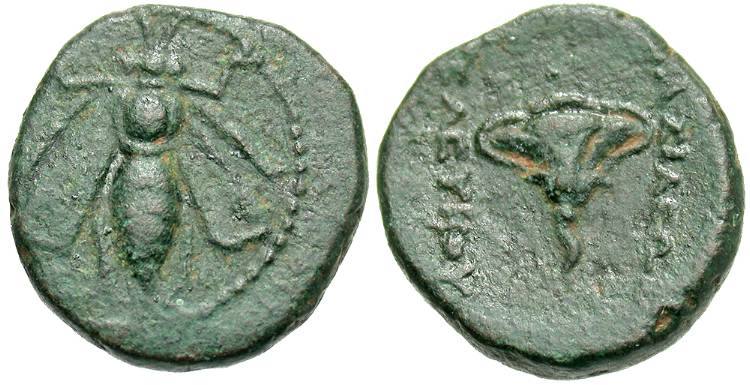
Seleukid Kingdom. Seleukos IV Philopator (?). 187-175 B.C. Æ (12 mm, 2.19 g, 1 h). Uncertain mint, perhaps in northern Syria (?). Bee with straight wings / [Β]ΑΣΙΛΕΩΣ [Σ]ΕΛΕΥΚΟΥ, rose. Unpublished. A unique and highly interesting coin! Attractive dark green patina. Good very fine.
The present bronze coin of denomination D represents an incredible opportunity to the Seleukid specialist as it belongs to a truly elite group of bronzes featuring the enigmatic and very un-Seleukid type of a bee. The bee is most commonly associated with the mint of Ephesos in Ionia. However, Seleukid bee reverse types are known to have been employed for extremely rare issues of Alexander I Balas from Ekbatana (SC 1875, known from 2 specimens) and Antiochos VII Sidetes from an uncertain mint west of Iran (SC 2135, unique). The only time that a bee ever appears on the obverse of a Seleukid coin is on a unique bronze coin of Seleukos IV Philopator from Susa (SC 1350). The obverse was normally reserved for the ruler portrait or depictions of patron deities. The reverse compounds the interest and rarity of the coin in its use of the equally un-Seleukid type of a rose - the badge most frequently associated with the coinage of Rhodes. Seleukid rose reverses occur on issues of Alexander I Balas at Laodikeia in Phoenicia (Berytos; SC 1828, known from 2 specimens) and Antiochos VIII Grypos at Antioch (SC 2316).
The legend identifies a King Seleukos as the issuing authority, but gives little help in identifying which of the six possible rulers of this name this may be. Considering that the other known appearances of bee and rose types occur on issues dated no earlier than 187 B.C. and no later than 96 B.C. makes it seem likely that the king in question ruled in the second century. Seleukos VI Epiphanes, who reigned in 96-94 B.C., should be ruled out since all of his known coinage carries his epithets as does the rose bronze of his father, Antiochos VIII. Since Seleukos V was killed by his mother, Kleopatra Thea, in 125 B.C., when he attempted to ascend the Seleukid throne, he can also be removed from the list of possibilities. This would leave Seleukos IV Philopator (187-175 B.C.) as the only king Seleukos who reigned in the second century and was named on his coins without any additional epithets.
If our unique bronze was struck under Seleukos IV, it may be a previously unknown issue from the mint of Susa, although this seems unlikely as the flan does not exhibit the pronounced beveled edge usually found on the cast flans employed at this mint. The absence of serrate edges and central depressions makes it certain that the coin was not struck at Antioch on the Orontes or any of the Phoenician mints under Seleukos IV, but otherwise the style seems western (perhaps north Syrian?).
At Susa the bee type would have served as an emblem of the local goddess, Artemis-Nanaia, just as the insect was a symbol of Artemis in Ephesos. The Susian temple of Artemis-Nanaia was rich in gold and attracted the unwelcome attention of Antiochos IV Epiphanes - the brother and successor of Seleukos IV - during his eastern campaign of 165-164 B.C. He attempted to plunder the temple in order to fund his campaign, but was beaten back by its priests. When he died of a sudden mysterious illness in 164 many ancient commentators ascribed this to the vengeance of the goddess.
Unfortunately, the meaning of the rose on this and the other Seleukid issues remains obscure. We have few details about any potential relationship between the Seleukid dynasty and Rhodes in the second century, although Rhodian bronzes do start to appear in the Levantine find record at this time. Earlier, in 226 B.C., the grandfather of Seleukos IV, Seleukos II Kallinikos, had contributed 10 quinqueremes, 200,000 medimnoi of grain, 10,000 cubits of timber, and 1000 talents of hair and resin, and offered trading privileges to the Rhodians after their island state was devastated by earthquake. Of course, it could be that the rose type was adopted merely because it was associated with a popular foreign coinage that was especially well regarded by mercenaries. This may be the same reason that the Athenian New Style type of the owl on an overturned amphora was chosen for a joint reign issue of Kleopatra Thea and Antiochos VIII (SC 2263).
[Our sincere thanks go to Oliver Hoover for contributing this extensive and enlightening commentary].
- Offered By: Barry P. Murphy
- Lot #: 112
- Listing #: 193609
- Closed: Thursday, April 17, 2014 5:37:00 PM CT
- Estimate: $150