
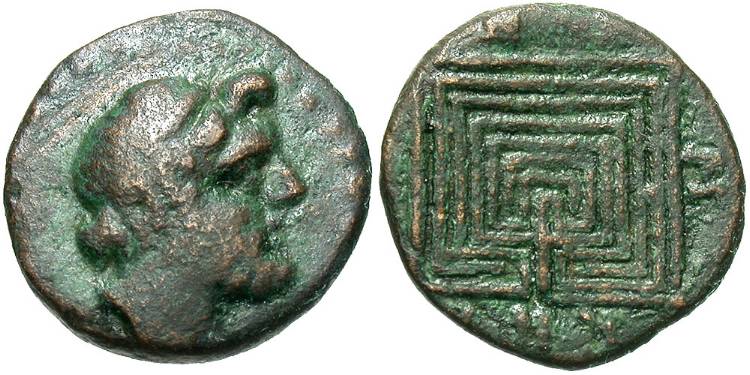
Lot 65: Crete, Knossos. 3rd-2nd centuries B.C. Æ. 
AUCTION: Triskeles - Auction 15 (Auction 318)
- Sold Winning Bid: $355
- 7 Bid(s)
Crete, Knossos. 3rd-2nd centuries B.C. Æ (14 mm, 2.14 g, 12 h). laureate head of Zeus right / KN[Ω]/Σ-[I/Ω]N, the Labyrinth of King Minos. Svoronos 105, pl. VI, 27 (same dies); Joy 475 (same dies); SNG Copenhagen 385. Brown and green patina. Very fine.
Knossos, the famous city of the mythical King Minos, is closely linked to the mythical tales of Daidalos and Ikaros, Theseus and Ariadne, Minos and Pasiphai, and of course, the Minotaur and the Labyrinth. According to legend, Daidalos built the labrynth at the request of King Minos, who wanted a secure place to confine the son of his wife, Pasiphai. The son - the Minotaur - was the unnatural result of the union of Pasiphai with a sacrificial bull, and was a monstrously half-human and half-bull. Daidalos cleverly built the labrynth so that the Minotaur could never escape (and according to Ovid, in doing so almost lost himself within its walls). Each year seven youths and seven maidens were brought from Athens, at the time subject to Knossos, to be sacrificed to feed the Minotaur. One year, wishing to free Athens from this ghastly tribute, Theseus, son of King Aigeus of Athens, connived with his father to join the next shipment of youths so that he could slay the Minotaur and free his fellow victims. With the help of King Minos'' daughter, Ariadne, he smuggled into the labryinth a sword and some string to help him navigate his way out again. He slew the beast, but on his return voyage to Athens he neglected to raise a white sail, the signal by which his father the king would know of his success. King Aigeus, in despair at seeing a black sail on the returning ship, hurled himself into the sea, which now was henceforth called the Aegean.
At the beginning of the 20th century Sir Arthur Evans excavated the palace complex at Knossos. Because of it''s sprawling nature and intricate maze of rooms and interior courtyards, some scholars have equated it with the Cretan Labyrinth. Knossos was one of the most important mints of the island, and began striking coinage during the 5th century B.C., shortly after both Gortyna and Phaistos had done likewise. The labyrinth, of course, featured as the principal reverse subject for the coin engravers throughout the duration of Knossos'' minting, even during Roman times. At first the maze is often shown in a sort of swastika form, but subsequently it appears as either a circle, or as here, in square form.
- Offered By: Barry P. Murphy
- Lot #: 65
- Listing #: 225932
- Closed: Tuesday, December 15, 2015 4:21:20 PM CT
- Estimate: $300