
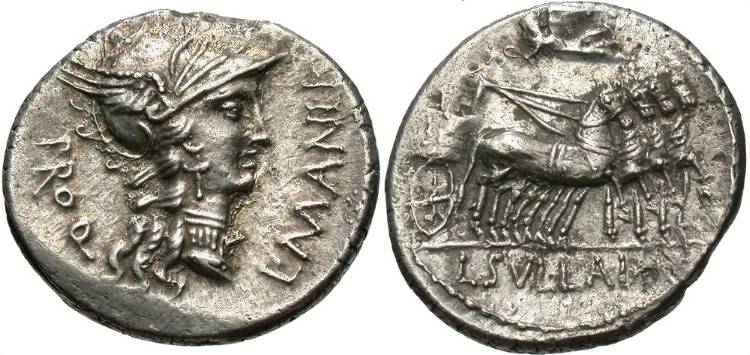
Lot 239: L. Manlius Torquatus and L. Cornelius Sulla. 82 B.C. AR denarius. Military mint traveling with Sulla in Italy. 
AUCTION: Triskeles - Auction 15 (Auction 318)
- Sold Winning Bid: $395
- 11 Bid(s)
L. Manlius Torquatus and L. Cornelius Sulla. 82 B.C. AR denarius (18 mm, 3.73 g, 8 h). Military mint traveling with Sulla in Italy. L · MANLI before, PRO Q behind, helmeted head of Roma right / L · SVLLA IM in exergue, Sulla, togate, holding branch and reins, driving triumphal quadriga right; above, Victory flying left crowning Sulla with laurel wreath. Crawford 367/5; Sydenham 757; Manlia 4. Light porosity on the reverse. Extremely fine.
Rome during the early first century B.C. was a hotbed of social and political strife, with the main issues being the disaffection of the Italian allies which culminated in the Social War (90-88 B.C.), and the struggle between optimates and populares. The optimates were the conservative traditionalists of the Roman senatorial order, and were opposed to the popularist politics of the populares, who utilized the popular assemblies and the tribunate to pass legislation. The former were led my Sulla, the latter by Marius. Things came to a head in 88 B.C. when Sulla, who as the consul assigned with the coveted task of leading Rome against Mithradates VI of Pontos, had his command revoked and transferred to Marius. When he received this news, Sulla was encamped with his veterans from the Social War waiting to cross into Greece from southern Italy. He promptly turned his armies about, marched on Rome, and took the city. Marius fled to Africa and Sulla was reassigned the task of prosecuting hte war against Mithadates.
Although a wily and tenacious opponent, Mithradates was no match for the concentrated might of Rome, and was consistently outmaneuvered by Sulla. The latter, however, was distracted by his political interests in Rome, and in secret negotiations with Mithradates, he concluded a lenient treaty, sparing the Pontic king for personal gain. In 83 B.C. Sulla again marched on Rome, in the interim having been declared an outlaw. The newly elected consuls, L. Cornelius Scipio Asiaticus and C. Norbanus levied and prepared armies of their own, but their forces were no match for the veteran soldiers led by Sulla, and after the Battle of the Colline Gate, Sulla entered Rome as conqueror on November 1, 82 B.C. The Senate soon appointed him dictator, and Sulla was able to insitute several consitutional reforms. This coin was struck in Italy during Sulla''s second march on Rome, under the authority of the proquaster L. Manlius Torquatus. The reverse shows Sulla in the triumphal quadriga, while according to Crawford the head of Roman on the obverse was "perhaps intended to proclaim an identification of Sulla''s cause with that of the res publica... and his intentions of restoring it." (RRC I p. 387).
- Offered By: Barry P. Murphy
- Lot #: 239
- Listing #: 231290
- Closed: Tuesday, December 15, 2015 5:19:20 PM CT
- Estimate: $300