
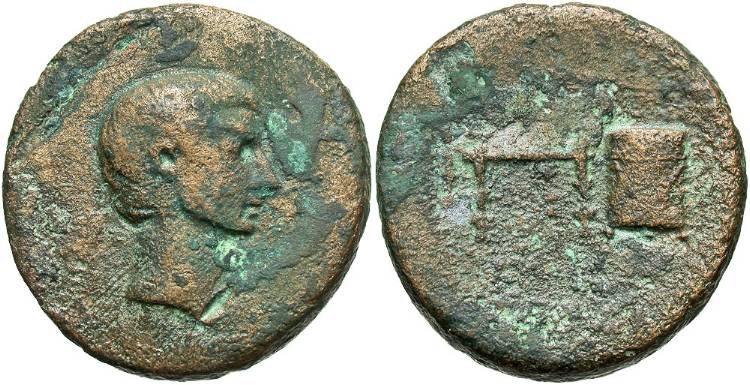
Lot 181: Asia Minor, Uncertain mint. Gaius Sosius(?). Questor, 39 B.C. Æ. 
AUCTION: Triskeles - Auction 16 (Auction 319)
- Starting Bid: $90
- 0 Bid(s)
Asia Minor, Uncertain mint. Gaius Sosius(?). Questor, 39 B.C. Æ (29 mm, 20.91 g, 12 h). Bare head right / Fiscus, sella, quaestoria and hasta; below, [Q]. RPC 5410; FITA 13-9. Rare and intriguing. Rough brown surfaces. Nearly very fine.
RPC notes fifteen examples of this issue, one of which is noted in RPC I supplement 1. This latter has a star countermark (GIC 434) on the obverse, and it is noted in the supplement that the star countermark ""seems to be the same as on the coins of Sosius from Zacynthus, but the two northern Turkish provenances makes this puzzling."" RPC 5409, of which twenty-six examples are noted, has identical types but is struck in copper. It is also generally found in northern Turkey.
In our opinion, CNG's commentary of the Freedman specimen (Triton V, 521; RPC 5410.12), cited here in its entirety, is very informative:
""This coinage has previously been attributed to a Macedonian mint with identification of the portrait as Brutus (Friedlander) or Caesar (Grant). RPC presents a case for a Cilician or Syrian origin, supported by find data, with a suggestion that the portrait is Octavian(?), although the portrait is quite unlike those of Octavian from elsewhere. Issues of similar portrait style, perhaps by the same engraver, include the Princeps Felix coinage, RPC 4082-3, from Cilicia.
""In our opinion, both sets of Cilician or Syrian issues portray Sosius, a leading general of Mark Antony. Sosius was quaestor (symbolized on this coinage with a Q and the symbols of the office) in 39 BC. The island of Zacynthus, a fleet station of Antony's, issued coins in the name of C SOSIVS Q (RPC 1290), C SOSIVS IMP (RPC 1291), C SOSIVS COS DESIG (RPC 1292), and C SOSIVS COS (RPC 1293). The first of these issues coincides with the dating of this coin. Note that both include the title 'Q'.
Sosius was governor of Syria in 38 BC. Antony supported Herod the Great against his rival Antigonus, and Josephus describes how Sosius commanded the Roman forces in support of Herod's claim. Sosius captured the island and town of Aradus in 38 BC and Jerusalem in July of 37 BC, for which he was acclaimed Imperator. Josephus notes that he was about to allow the soldiers to loot the fallen city and slay its inhabitants, when Herod intervened. Herod asked if the Romans, by emptying the city of money and men, had a mind to leave him to become king of a desert? Herod paid the troops a donative instead, and Sosius himself received a 'most royal bounty'. Sosius called the defeated king the feminine name 'Antigona' and imprisoned him for Antony to execute later.
In 36 BC Sosius assisted Octavian and Agrippa against Sextus Pompey and afterward probably stayed in Rome, where he celebrated a triumph in Rome in 34 BC and was consul along with Domitius Ahenobarbus in 32 BC. During his consulship, he rebuilt the Temple of Apollo, which had been constructed in 431 BC. He introduced a measure in the Senate to censure Octavian, but this was vetoed by a tribune. As war between Octavian and Antony approached, Sosius fled Octavian and Rome along with some 300 senators. At Actium in 31 BC, Sosius commanded the left wing of Antony's naval forces. This wing of heavy ships entered the battle first, but was overwhelmed by the smaller, faster ships of Agrippa, commander of Octavian's fleet. Meanwhile, Cleopatra, and then Antony, escaped through the opening created by the movement. Sosius fought on, surrendered and was spared by Octavian.
- Offered By: Barry P. Murphy
- Lot #: 181
- Listing #: 234070
- Closed: Friday, June 3, 2016 6:30:00 PM CT
- Estimate: $150