
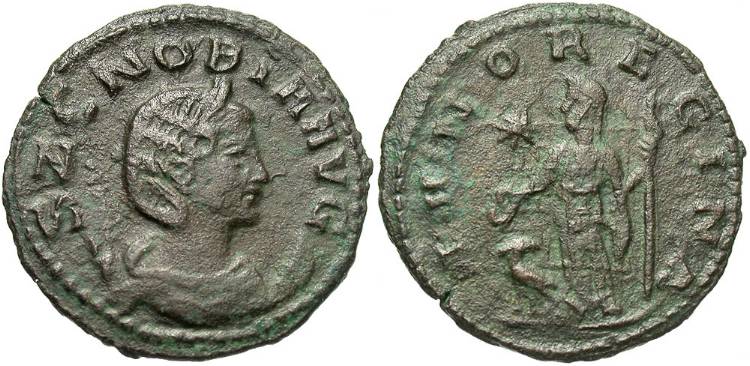
Lot 305: Zenobia. Usurper, A.D. 268-272. Æ antoninianus. Antioch, A.D. 272. Zenobia, Queen of the East. 
AUCTION: Triskeles - Auction 16 (Auction 319)
- Sold Winning Bid: $5,050
- 11 Bid(s)
Zenobia. Usurper, A.D. 268-272. Æ antoninianus (20 mm, 3.28 g, 6 h). Antioch, A.D. 272. S Z?NOBIA AVG, diademed and draped bust of Zenobia right, set on a crescent / IVNO REGINA, Juno standing facing, head left, holding patera and scepter; at feet to left, peacock standing left, head right; in left field, star. RIC 2 corr. (no star); BN 1267. Of the highest rarity. Dark brown patina with some green. Very fine.
The eastern client kingdom of Palmyra ruled by Odenathus served as a buffer between the Sasanid Persian and Roman empires. In the aftermath of the humiliating defeat and capture of the Roman emperor, Valerian I, by the Persians under Shapur I in A.D. 260, the eastern Roman provinces were in a state of panic. Gallienus was too far away to be able to effectively counteract any effort of the Persians should they decide to invade the eastern Roman provinces, so he granted Odenathus extraordinary powers to deal with any situation that arose. Odenathus did engage the Persians while they were marching back into their own borders, and inflicted a defeat on them, but otherwise the Persians seemed content to leave Rome in peace.
Soon, however, Valerian’s former a rationibus, Fulvius Macrianus, rose in revolt at Samosata. Having a deformed leg, he himself was deemed unfit to assume the imperial office, so he named his two sons, Macrianus and Quietus, as joint emperors. While the elder Macrianus and his son of the same name marched to confront Gallienus in the west, his younger son, stayed behind in the east. Odenathus, who had remained loyal to Gallienus, besieged Quietus in Emesa, where the young usurper was killed by the city’s inhabitants.
After the defeat of the sons of Macrianus and with Gallienus still occupied in the west, Odenathus became the effective ruler of the Roman east. He paid nominal loyalty to Rome, but he was the undisputed master of eastern affairs. In this capacity he waged war against the Persians, inflicting several defeats and reclaiming the entirety of Roman lands that had been lost to them. Subsequently, in A.D. 266 he marched north into Bithynia to repel an invasion of Germanic barbarians, but during the course of this campaign he was assassinated, leaving his widow, Septimia Zenobia, as regent for his young son, Vaballathus. After Gallienus’ death in A.D. 268, Zenobia used the upheaval to expand Palmyrene power and to more firmly establish her separatist kingdom. With this in mind, she seized control of Egypt, the bread basket of the Roman Empire. She also ordered to be struck coins in both her name, which are exceptionally rare, and in the name of her young son.
The imperial coinage of Zenobia and Vaballathus is interesting in that it poignantly illustrates the short life of the Palmyrene Empire. The first issues, while Zenobia was still firmly in control of eastern affairs, are exceedingly rare and name mother and son as independent rulers, both with imperial titles. Additionally, these coins have the portraits with emblems of imperial authority: Zenobia’s portrait is diademed and rests on a crescent, while that of her son is shown wearing a radiate crown. The insecurity of the regime after Aurelian’s invasion becomes quickly apparent, however. The independent coinage in the names of both Zenobia and Vaballathus ends entirely, and is replaced with the much more substantial and placatory issue bearing the radiate bust of Aurelian along with the laureate bust of Vaballathus, leaving no doubt as to the latter’s subservient position in regards to that of the true emperor. The extreme rarity today of coins in the names of either Zenobia and Vaballathus as independent rulers may indicate a recall, which if so would have been another conciliatory gesture of Zenobia to placate Aurelian.
After Aurelian stabilized the military situation in the west, he marched east to confront Zenobia’s Palmyrene Empire. In the ensuing conflict, Palmyra was sacked and the eastern provinces brought back into the fold of the Roman Empire. The empress Zenobia and her young son were both captured, and although Vaballathus did not survive, Zenobia was brought back to Rome where in A.D. 274 she was paraded bound in gold chains during Aurelian’s magnificent triumph. Her subsequent fate is uncertain, but tradition had her spending her remaining years in comfortable retirement in Italy, having been freed by Aurelian who was impressed by her dignity.
- Offered By: Barry P. Murphy
- Lot #: 305
- Listing #: 237198
- Closed: Friday, June 3, 2016 7:32:00 PM CT
- Estimate: $5,000